
With the recent avocado toast controversy in the news, it may surprise some to know that Millennials continue to make up the largest group of homebuyers. In a recent NBC News article, Herb Weisbaum breaks down the home shopping and buying trends of this diverse group.
Millennials are growing up, settling down and looking to buy a house — for the extra room and the investment opportunity.
Millennials were the largest group of home buyers (34 percent) for the fourth consecutive year, according to NAR’s 2017 Home Buyer and Seller Generational Trends study. By comparison, baby boomers were 30 percent of buyers.
“That myth that millennials don’t want to own things is not true,” said Jeremy Wacksman, chief marketing officer at the Zillow Group. “Millennials are not just starting to buy homes; they’re powering the housing market.”
Most millennials are first-time buyers. In many parts of the country, they’re dealing with a hot housing market where home prices are soaring and supply is limited. And even though they are typically two-income families, home prices are outpacing wage growth.
Millennials are focused on being able to afford their purchase. They want a property that is well within their budget, real estate experts told NBC News.
Jacob Berg, a 33 year old bookkeeper, and Bianca Rose, a 27 year old insurance agent, recently bought a home in Valencia, California. It took them a year to find the right place: a small house (900 sq. ft.) with two bedrooms, two bathrooms and a two-car garage. They paid $430,000 for it — a price that was well within their comfort zone.
“We didn’t take into consideration having good jobs,” Berg said. “Unforeseen things can go wrong. If we had to go get a minimum-wage job, we would still be able to afford to make our house payments.”
Berg and Rose see their new house as a step up from living in an apartment, as well as a long-term investment. They hope to rent it out some day and move to a bigger place.
Read the full article: Who’s Powering the Housing Market? Surprise! It’s Millennials
It’s possible that the color paint in your home could be an important factor when it comes to selling your home, potentially causing your home to sell for more or less. According to this recent Zillow Porchlight article by Alexa Fiander, the colors in your home may affect how much your home sells for. Find out the results of 2017 Paint Color Analysis below.
For-sale listings with cool, neutral wall colors sell for more money, according to Zillow analysis.
A fresh coat of paint in the right color may help sell a home for more money.
Homes with rooms painted in shades of light blue or pale blue/gray can sell for as much as $5,440 more than expected, according to a new Zillow report.
Zillow’s 2017 Paint Color Analysis looked at more than 32,000 photos from sold homes around the country to see how certain paint colors impacted their sale price on average, when compared to similar homes with white walls.
Curious what colors may help you sell your home for more? See below for the full results of the 2017 Paint Color Analysis.

Homes with blue kitchens, often found in soft gray-blue, sold for a $1,809 premium.
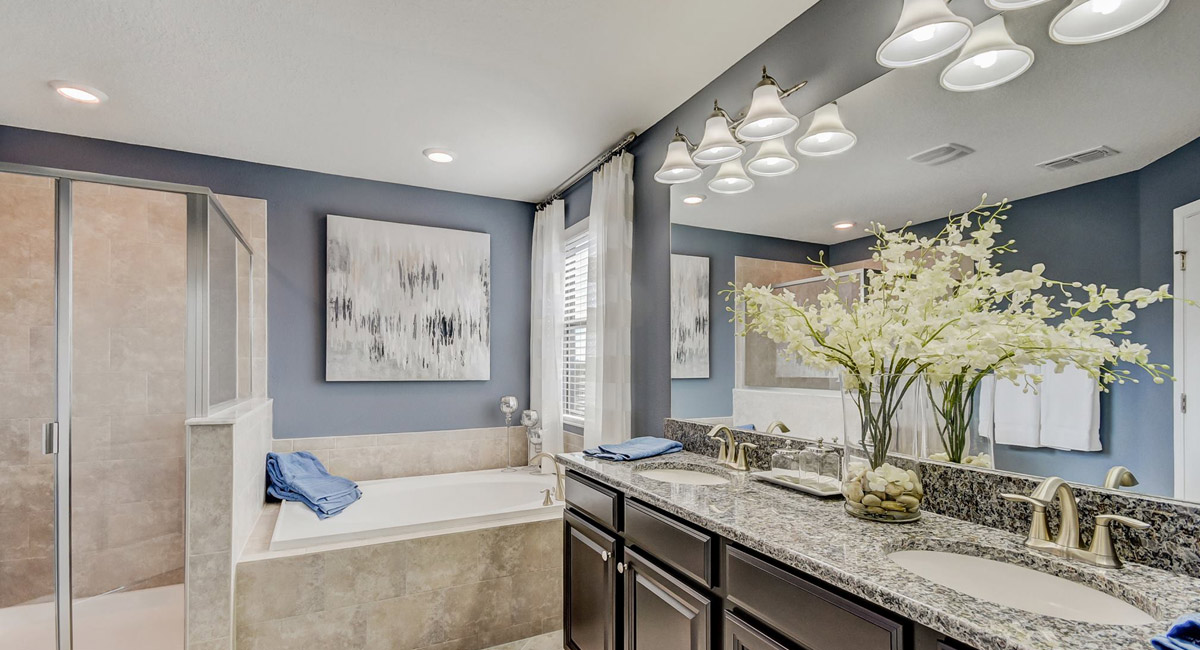
Homes with light pale blue to soft periwinkle blue bathrooms sold for $5,440 more than expected.

Turns out homes with light beige, pale taupe or oatmeal-colored living room walls sell for $1,926 more than expected.
Selecting the right paint color is one of many factors that may affect why a home sells faster or for more money. Walls painted in cool neutrals like blue or gray have broad appeal, and may be signals that the home is well cared for or has other desirable features.
Some colors may actually deter buyers. Homes with darker, more style-specific walls like terracotta dining rooms sold for $2,031 less than expected. However, a lack of color may have the biggest negative impact as homes with white bathrooms sold for an average of $4,035 below similar homes. Zillow’s full report can be found here.
Read the full article here.
Are you looking to put your home on the market this Spring? Get the latest news on what other home-sellers are saying so you can learn what to expect. This recent Redfin article by Jeffrey Marino explains how home-seller confidence is strong this season.
The strong March housing market was followed by a significant boost in home-seller confidence this April.
In its latest Home-Seller Sentiment Survey, Redfin surveyed nearly 900 homeowners, about 20 percent of whom either said their home was currently listed for sale or expressed plans to sell within the next year, and are therefore considered “home sellers” for the purpose of this report.
Among those 179 home sellers, one in four said they had no concerns when asked what their top three concerns were regarding selling their home, ironically causing “no concerns” to rank in the top spot on the list.
This is a nine-point jump in confidence from when we last surveyed home sellers three months ago. In January, 16 percent of sellers selected the option “none,” and this response ranked in the eighth spot on the list of concerns.
There was also a decline in the percentage of sellers expressing concerns about finding a replacement home, dropping from the third spot in January when 24.1 percent of sellers expressed this concern to fifth place in April when 18 percent had this response.
“Despite strong sentiment among current home sellers, the numbers show prospective sellers have been very slow to list their homes. New listings dropped 2.3 percent in the first three months of the year compared to the same period last year,” said Redfin chief economist Nela Richardson. “Would-be sellers are likely waiting for prices to peak; they’re trying to time the market to fetch the largest possible gain. Whether the confidence of the current cohort of sellers translates into more new listings in the coming months is the number one question that determines whether 2017 will be a good year or a great year.”
The fact that home sellers were emboldened in April is also reflected in a slight shift toward a more aggressive pricing strategy. The share of sellers reporting they would price high because they believe negotiation in inevitable increased almost six percentage points from 15.4 percent in January to 21.1 percent in April.
Are you looking to sell your home and buy new this season? Join the conversation with Lennar Homes on Facebook!
Prospective homebuyers toured the four professionally decorated models and inventory homes at Mountain Crest – and they loved what they saw! During the grand opening, attendees enjoyed two days full of live music, delicious barbecue by Cue BBQ Restaurant, cooking demonstrations by Publix Aprons cooking school, bounce house, balloon artists and face painting at the fun event that introduced this master-planned resort living community in Cumming.
“We are so pleased with the turnout we had during the grand opening of Mountain Crest,” said Steve Atchison, Division President. “We knew this community would be a winner and the traffic during our event showed that. It was an exciting day made even more special with some buyers purchasing a new home! If you missed the event, I encourage you to stop by our Welcome Home Center and see what we have in store for you in this wonderful master-planned community.”

Offering homes priced from the high $200s – $600s, Mountain Crest’s master plan includes eight distinct phases, including different single-family neighborhoods with 2-story and ranch home plans on 60 ft., 75 ft., and 90 ft. homesites; a vibrant gated townhome community called Stablegate at Mountain Crest; and Bridlewood at Mountain Crest, a collection of single-level ranch homes. There’s something for everyone at Mountain Crest.
Lennar Atlanta’s thoughtful design for Mountain Crest highlights its beautiful natural surroundings and rolling hills while it exhibits the company’s environmental sensitivity. Situated on 440 acres, over 30% of the community is green space. Great care will be given throughout each building phase to respect the existing slope of the land and minimize impact to streams and creeks. Lennar Atlanta estimates that construction will be completed in 7 to 9 years.
All homeowners will enjoy Mountain Crest’s multi-million dollar amenities that will make living here feel like being on vacation year-round, such as:
For more information or to take a tour of the models at Mountain Crest, call 470-239-1180 or visit www.Lennar.com/Atlanta.
Is now the best time to buy a new Lennar home? According to a recent CNBC article by Diana Olick, homes are selling at a record pace this spring, thanks in large part to increasing demand and lower inventory. Whether you’re buying your first home or next home, you may not want to wait too long. Not only are homes selling quickly, but low mortgage rates help to make home buying more affordable. Strong demand can also benefit home sellers looking to move up into a new home. According to recent reports, the average home went under contract in just 49 days!
Homes are flying off the shelves this spring, as demand rises and supply continues to drop.
Record high prices in some local markets are not thwarting hungry buyers, as they rush to take advantage of the lowest mortgage rates of the year.
Home sales jumped nearly 9 percent in March compared with March 2016, even as the number of homes for sale plunged 13 percent, according to a new report from Redfin, a national real estate firm.
That demand dynamic further increased competition in the market, resulting in the fastest average sales pace since Redfin began tracking in 2010. The typical home went under contract in just 49 days, down from 60 days a year ago.
Steep competition also pushed the median price of a home sold in March to $273,000, up 7.5 percent year over year.
“At some point consumer budgets will stagger behind the fast pace of price appreciation,” said Nela Richardson, Redfin’s chief economist. “The combination of low inventory, high prices and strong competition will continually challenge first-time buyers this year and they are the cornerstone of the housing market.”
Homebuilders are benefiting from the lack of supply of existing homes for sale. Mortgage applications to purchase a newly built home in March were up 6.7 percent compared with a year ago to the highest level since the Mortgage Bankers Association began tracking this metric in 2012.
Read the full article: Homes this spring are selling faster than ever
Shafter, Calif. – March 2017 – Spring season has arrived and Lennar is inviting everyone to hop on over to their Spring Eggstravaganza event at Gossamer Grove. Join in the fun on Saturday, April 8th from 11 a.m. to 2 p.m. at Gossamer Grove’s Flight Park.
“This is going to be such a great day that you won’t want to miss,” said Susan Wilke, Vice President of Sales and Marketing for Lennar Central Valley. “Grab your friends and family and help us kick off Spring with a festive and exciting event the whole family will love.”
Attendees will enjoy delicious food, fun seasonal crafts for everyone and an egg hunt for the kids! Plus, there will be a very special guest that kids of all ages will love – a visit with the Easter bunny. Be sure to get there early and have the opportunity to experience all the festivities!
In addition, prospective homeshoppers will have the opportunity to learn more about the community and tour the 12 professionally decorated model homes.
Community members or anyone interested in attending the event is encouraged to visit the Gossamer Grove Facebook page for updates. Flight Park is located within Gossamer Grove, off 7th Standard and Calloway.
Gossamer Grove is a masterplanned community that will be built atop more than 1,000 acres and will include more than 3,000 homes, two schools, ten parks including Flight Park, meant to pay homage to Shafter’s deep-rooted history in aviation, and commercial and retail development, including city services.
Gossamer Grove will be built in phases, the first of which is now selling and has quick move-in homes available! The first phase consists of three series of home styles by Lennar, The Cambridge Collection, The Chateau Series and The California Series.
For more information on this community or to view move-in ready homes, visit www.lennar.com/gossamergrove.
For a list of new home communities throughout the greater Bakersfield area, visit www.lennar.com/bakersfield.
With hundreds of communities nationwide and homes designed for first-time, move-up and luxury homebuyers, Lennar has grown to become one of the nation’s leading and most respected homebuilders and proudly remains steadfast in their commitment toward quality, value and integrity. Lennar has a longstanding history of building exceptional homes in only the most well planned and desirable locations throughout the country.
Many have their assumption about millennials financial choices, but can you tell the money myths from fact? When it comes to big purchases such as home and car buying, most millennials would like to own, but financially might not be able to afford it. Their aspirations remain similar to past generations, but it appears that it might just take them more time to have the funds to do so. This recent CNBC article by Eric Rosenbaum shares millennial money myths that many people have come to think true.
When it comes to trying to get inside the head of millennials, don’t buy the buzz about the “don’t own” economy.
The success of start-ups like Netflix, Spotify and Uber have led to predictions that future Americans will choose not to own and drastically shape the future consumer society. But when it comes to big purchases — the kind that can be very good or very bad financial decisions — millennnials are not that different than past generations.
Fifty-three percent of millennials own homes and overall, 88 percent of millennials who do not own a home have one on their wish list, according to a survey conducted by Qualtrics, a Provo, Utah-based survey software firm, and venture capital firm Accel Partners (a Qualtrics investor).
“The sharing economy is here to stay and has changed how many people work and live. But it doesn’t mean that traditional purchases such as cars and homes are less enticing to millennials,” said Mike Maughan, head of brand growth and global insights at Qualtrics — and a millennial himself.
Nearly 80 percent of millennials own cars and 75 percent of millennials who don’t own a car aspire to own one now, the Accel + Qualtrics Millennial Study 2017 found.
“The world is changing, but in some areas maybe not as much as we think,” Maughan said. “They’re not afraid to put down roots,” he said. He noted that the number of millennials who aspire to own homes holds steady whether they live in metropolitan or rural areas.
Maughan said the data is even more important now as millennials enter their peak spending years.
Homes, guns, Siracha sauce: What millennials purchase
(Source: Accel + Qualtrics Millennial Study 2017 )
Millennials may be a transitional generation when it comes to consumer preferences, but busting the myths of the “Don’t Own” economy is an important part of ensuring that financial decisions made today by millennials are the best ones for their future.
Sophia Bera, founder of Gen Y Planning and a member of the CNBC Digital Financial Advisor Council, said she sees evidence that millennials are truly transitional when it comes to views on home ownership.
“I am noticing more millennials buy or rent depending on area they are in, seeing people go from renting to buying to selling and renting again to buying again, as opposed to buying and hold that property for decades,” Bera said.
In one way, home ownership is working out well alongside millennial generation developments. “They are much more likely to become landlords, buying with the ability to rent it out or ‘Airbnb it,’ Bera said.
The financial advisor also sees great potential downside to home ownership as a default consumer position, stemming from a core millennial need greater than ownership — mobility.
If you’re weighing the pros and cons of buying a new home, monthly cost is likely a big factor. But if you’re only considering and comparing the total monthly costs to renting, you may be leaving out a big piece of the equation. Jonathan Smoke for Realtor.com explains the math for the rent vs. buy calculations.
There’s about $13.1 trillion stashed away in the United States, in plain sight. Where? In our homes!
Do we have your attention yet?
That’s the total value of the equity held by over 75 million U.S. homeowners, according to the latest estimates from the Federal Reserve Board. And that works out to almost $175,000 per owning household.
This is unmistakable evidence that homeownership is a critical building block of household wealth. Owning a home is a key reason why the median net worth of a homeowner is almost $200,000 while the median net worth of a renting household is just over $5,000.
Sure, part of that is because owners were able to pony up a chunk of money to put down on a house, and to qualify for a mortgage. But the act of paying for a mortgage actually helps produce more wealth, by freezing payment amounts and building equity through forced savings.
A 30-year amortized, fixed-rate mortgage is a beautiful thing. It provides an affordable path to buying a home while locking in today’s cost of that home for the life of the loan.
The traditional rent versus buy argument compares the total monthly costs of buying a home with a mortgage with the corresponding rent. So that comparison is relevant when it comes to representing the housing choice trade-off in clear cost terms.
Two years ago, that head-to-head heavily favored buying, thanks to very low mortgage rates and lower prices. Back then, more than three-quarters of the counties in the country saw lower buying costs than renting costs.
With prices and rates higher now, less than half of the counties in the country see math that favors buying.
But those raw numbers hide the fact that unlike a rent check, a percentage of every monthly mortgage payment—after the lender is paid interest—goes toward the owner’s home equity. That means it’s really a forced savings plan.
Over time, less of the mortgage payments go toward interest and more go toward equity, so the savings power is enhanced further.
Read the full article: The Misleading Math Behind the Rent vs. Buy Calculation | realtor.com®
For some of us, tax refunds can mean extra money back in our pockets. Maybe you’re considering using it towards your next vacation or to help pay off bills. If you’re a homeowner, you may want to consider a few different ways you can use your tax refund that may be more beneficial for your future. This recent U.S. News & World Report article by Marietta Rodriguez, shares what you can do with you refund if you’re a homeowner.
Build a home emergency fund. No matter the amount of a refund, homeowners should look hard and long at setting aside a portion of their cash for their homes. According to studies by the Federal Reserve and others, millions of Americans, including many homeowners, don’t have a $400 cash reserve to cover unexpected emergencies like a water heater or other major appliance needing to be replaced or repaired.
Because home prices have been increasing since the Great Recession and income growth has not been keeping pace, buyers have been less able to set aside money for the eventual costs that being a homeowner entail while saving for a down payment.
While most mortgage lenders require that homeowners have a reserve fund in place when they purchase their home, over time reserve funds can be drawn on for other expenses. Essentially, an out of sight, out of mind mentality sets in when everything is going well with the home.
But home repairs can be costly, and not planning for them could be a sudden financial burden. For example, experts recommend that heating and air conditioning systems are checked each year at a cost usually less than $100, and serviced every few years – at a cost of few hundred dollars – but if these systems break down and need to be replaced, the costs run into the thousands of dollars.
Pay down mortgage and credit card debt. Twenty-one percent of consumers in the NeighborWorks America survey said they would use their anticipated tax refund to pay down debt. Once an emergency reserve fund has been established, paying down debt is a top recommendation of housing and credit counseling organizations around the country.
Credit card interest rates far exceed what a homeowner could earn in a savings account. Although 60 percent of people don’t carry over credit card debt – and thus pay no interest – 40 percent of people do, and many of these are homeowners. Paying off credit cards as soon as possible can save hundreds of dollars or more in a given year.
Homeowners who regularly choose to put a little extra into their mortgage payment each month could shave years from their 30-year mortgage loan. It’s especially important to think about paying more on an adjustable-rate home equity line of credit. The Federal Reserve Bank of New York reported more than $470 billion of HELOC debt outstanding as of Sept. 30, 2016.
Many homeowners who have a HELOC will soon see their payments change from interest only – when none of the principal that was borrowed is being repaid – to a fully amortizing loan, where principal and interest is expected to be paid each month. The fully amortizing loan will cost considerably more.
Add to your retirement account. Many homeowners consider the rising level of their home equity as a major part of their retirement plan. But millions of homeowners, particularly low- and moderate-income homeowners have not seen their home equity recover from the Great Recession.
In fact, real estate information company Zillow reports one out of 10 homeowners owed more on their homes than they were worth in the third quarter of 2016. Importantly for homeowners whose houses are priced below the median level for their metropolitan area, the depth of negative equity is even greater – about 16 percent, according to Zillow. Home values are growing in these markets, but there is a long way to go.
Given that, homeowners who have the option of putting money aside for retirement should strongly consider that choice. Even if the refund that’s invested in a retirement account is small, every dollar set aside matters. Keep in mind that the money will have a chance to grow, particularly if there are several years or even decades before retirement.

