
It’s exciting to think about what a home will look like in the future, whether it’s more automation, greater connectivity, or something yet to be invented. From controlling your thermostat with your phone to keyless entries, new homebuyers find smart home features desirable and valuable. It’s not a surprise that accessible and inexpensive technology is catching on quicker than more expensive and complicated options. In this U.S. News & World Report article, Teresa Mears predicts the four smart home features buyers can expect to see in future new homes.
Smart refrigerators and other appliances. Few people are buying refrigerators that include an app to tell them when they’re out of milk. “I don’t think we’re quite there yet on the value proposition,” Galante says. But Hertzberg says he is starting to see some smart kitchen appliances in high-end homes. “Those things will go from wow factor to expected in the future,” he says. Controlling the stove and oven remotely is likely to catch on first.
Smart ventiliation systems. Look for heating and air conditioning systems that will not only adjust the temperature, but will also detect and compensate for humidity and air purity.
Smart building materials. Shingles will be able to notify you of leaks, drywall will detect moisture and wood framing will report termite infestations. “That’s the stuff that’s coming seven to 10 years down the line,” Galante says.
Smart irrigation. Precipitation sensors and moisture sensors for soil exist but aren’t wildly used. A new Houzz survey of landscaping trends found that 24 percent of homeowners doing an outdoor remodeling project were installing motion-sensitive lighting, but only 8 percent of respondents were adding precipitation-sensitive irrigation systems, which shuts off the sprinkler system when it rains, and only 2 percent were adding smartphone connected plant sensors.
Read the full article: 6 Smart Home Features That Have Caught On – and a Few That Will Soon | U.S. News & World Report
While I would love to magically turn into a person who loves to clean, it’s not likely to happen. When at home, I’d rather be relaxing, cooking or spending time with family, not sweeping or scrubbing. Thankfully, having the right tools can make cleaning tasks quicker and easier. When it comes to vacuums, how do you know which one to choose, or if the extra expense is worth it? If you’re in the market for a new vacuum, or need something to help get your (dirty) job done faster, consider this advice from Julie Pennell for Today.com.
1. Consider the kind of flooring you have. While this may seem obvious, McCabe points out that some people — including him before he started the research — might not put too much weight on this factor, but it’s really important. “If you have bare floors, you don’t need an expensive high-end vacuum,” he said. “But if you have shag carpets, you’re going to have to think about a different approach.” In their research, McCabe and his team found that vacuums featuring cleaning heads with a manual height adjustment work best for high-pile carpets.
2. Consider the size of your house. If you live in a smaller home, cordless vacuum cleaners are convenient, “But it really boils down to the quality of the battery,” he noted. “Look at the voltage — 18-20 is a good baseline. That gives you enough power to get chunks off the floor. For battery life, I’d recommend getting something would would last 11-12 minutes for smaller apartments. If you have two floors with carpet, you’ll probably want a plug-in because they’re better cleaners for the most part, and you don’t have to worry about battery life.”
3. Consider what you’ll be cleaning up. “There’s nothing inherently special about vacuuming up pet hair,” he said, “but if you have carpet you’ll definitely need a vacuum with a brush roller. And if you have lots of hairy pets, a canister is gonna fill up quickly, so a bagless one would make more sense.”
Read the full article and get recommendations: Tips for Buying the Best Vacuum Cleaner – TODAY.com
Anyone who has lived with a baby knows it’s never to early to start childproofing your home. Babies and toddlers develop quickly, and with their constant growth comes greater curiosity and mobility. Before you know it, that tiny baby will be crawling and exploring every room in their home. Thankfully, it’s not difficult or expensive to childproof. This helpful guide from Lee Wallender for Fix.com highlights the areas of concern in your home and how to keep your smallest household members safe from hidden dangers.
Before you begin, it helps to know what you are guarding against. The Centers For Disease Control and Prevention (CDC) has identified several ways our children can get hurt. Falls account for the majority of emergency room visits. While this mainly pertains to children falling down stairs, out of windows, or off high places within the home, furniture and high objects falling onto children is a frequent occurrence and should be guarded against.
The remainder of injuries result from electrical shocks and burns, water hazards, and accidental ingestion of common household cleaners and medicines.
At the same time, do not be alarmed by causes of injury reported in sensationalist news items. For example, gastrointestinal injuries resulting from children swallowing rare earth magnets were splashed across the headlines several years ago. Yet according to CDC, only 18 cases occurred from 2003 to 2006. Keep these statistics in perspective and realize that most injuries result from the obvious – stairs and furniture – rather than the exotic.
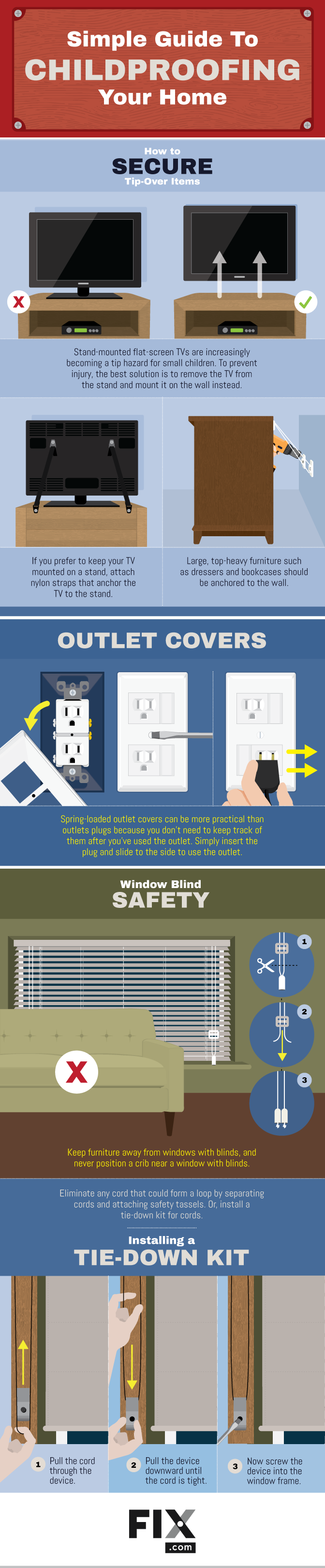
Read the full article: Childproofing Your Home | Fix.com
The benefits of owning a new home are numerous, whether you’re a first time home buyer or a retiree. New home owners avoid rising rental rates and the upkeep or costly repairs of an older home. As more empty-nesters put their home on the market, they’re considering which housing options make the most sense for financial stability during retirement. Jane Hodges, for The Wall Street Journal, weighs the pros and cons of the rent vs. own question facing retirees.
Rent or own? It’s a question many young adults face as they try to find the right balance between their housing needs and financial situations.
These days, many older homeowners are grappling with it, too.
Home-sales data and anecdotal evidence suggest that more baby boomers are putting for-sale signs on their homes this year, seeking to unlock the equity they have regained since the housing downturn.
They are selling more this year than in the last two years,” says Heidi Kelley, an agent with Keller Williams Leading Edge in Providence, R.I., who specializes in the senior real-estate market.
The National Association of Realtors, too, says the median age of home sellers has risen to 54 from 46 since 2009, an indication that empty nesters who were waiting for a housing-market recovery are starting to list their properties.
Of course, planting a for-sale sign in the yard raises the question, “Where to next?” And for baby boomers—especially those with oversize houses and inadequate savings—it is a decision that could have a major impact on how they fare financially in retirement, some experts say.
Although investors have been told for years not to think of their primary homes as investments, having a healthy chunk of home equity can make a big difference when it comes to planning retirement finances.
“If retirement savings present the risk of a shortfall, one of the best things you can do is liquidate real-estate assets,” says Christine Benz, director of personal finance at Morningstar Inc. “That’s more palatable than hearing you need to keep working until you’re 72.”
Andrew Carle, executive in residence at the Senior Housing Administration program at George Mason University and a senior housing researcher, says it is important for older consumers to consider their needs not just for the next few decades, but for the final one-third of retirement.
Read the full article: Should Retirees Rent or Own? – WSJ
The minimum down payment for your new home will depend on your financing, and may be lower than you think. It’s important to consider where you will store your funds, whether it’s from your savings or a gift from family. Scott Sheldon from Credit.com shares the 3 things you shouldn’t do with your new home down payment to avoid delays in securing your new home loan. If you have any questions about your new home mortgage, the professionals at Universal American Mortgage Company can help guide you through the process.
Let’s say you store your money in your parents’ bank account. It’s your money; you earned it, but mom and dad manage your finances. If you want to use this money, your folks would have to sign a gift letter, stating the money is donated, so your mortgage company knows it’s not another loan.
Even though the money is not technically a gift (it’s your money), your lender doesn’t view it that way. An account that is yours on paper is considered to be your money. An account that contains funds with another party’s name or even your name with that party is going to require more paperwork.
Keep in mind, if the money is true donor funds from mom and dad, they will need to provide that gift letter stating as much as well as a bank statement showing they have the ability to give such a donation.
Hiding your money at home in a safe away from the eyes and ears of banks does not help your case either. All financial institutions have strong anti-money laundering laws to prevent criminal activity. The money you use to buy a home must be in your bank account for a period of 60 days or the money can be gifted (see above).
Cash deposits from your “side jobs” will almost always create more questions and conditions from your mortgage lender. So, do yourself a favor: if you’re serious about buying a home, use a bank account to store your funding.
Checking accounts, believe it or not, can be problematic for homebuying. If you’re storing your homebuying funds in a checking account that you use to pay your monthly bills, it can appear on paper like you are spending your down payment! (It can also be problematic if you have donor funds deposited into your primary checking account for the same reason.)
Instead, you can consider keeping the money you plan to use to close on the home in a separate checking account you’re not taking money out of. Or a best practice is to keep your down payment funds in a separate savings account that generates little or no activity.
A solid best practice for receiving donor funds is to file the proper paperwork and have the donor wire the gift directly to escrow, bypassing your bank accounts altogether. Doing so will save you time, resulting in a smoother, faster loan process.
If you are trying to buy a home and need guidance, it’s smart to talk to an experienced mortgage professional. The homebuying process is always going to be paperwork heavy, but what you do with your money can make the difference between a straight line forward or jumping through hoops.
Source: 3 Things to Never Do With Your Down Payment | Credit.com
Learn more: Your guide to saving for a down payment
The year Ronald Reagan became the 40th president of the United States the median home price was $52,739. Sounds like a dream, but what would that mean in today’s dollars? A special report from the team at 24/7 Wall St gives insight into how home prices have really changed through the years.

People love telling stories about how a home purchased years ago for next to nothing is today worth hundreds of thousands of dollars or more. Truth is, those tales might be overestimating real estate as an investment. While a home bought in 1930 for around $6,000 may be worth roughly $195,000 today, when adjusted for inflation, the appreciation is not as impressive as it seems. Since 1930, inflation-adjusted home values have increased by a modest 127%, or less than 1% each year.
24/7 Wall St. reviewed real estate data from the Case-Shiller Home Price Index and the U.S. Census Bureau. According to research conducted by economist Robert Shiller, major increases in real estate values took place over two distinct periods: the post-World War II housing boom, and the subprime housing bubble leading up to the 2007-09 recession. Outside of these spikes, national home prices have remained relatively stable.
Several factors after World War II, during the first major increase in home prices, drove up housing demand. Government rationing during the war had caused a limited supply of homes, and the 1944 G.I Bill, which subsidized home purchases for millions of soldiers, further increased demand. While the construction of new homes increased considerably at this time, it was still outpaced by demand, and home values spiked.
Unlike the housing bubble that occurred 60 years later, the post-war housing boom stabilized. By the late 1940s, the national median home price had plateaued around $130,000, where it would remain roughly unchanged for the rest of the century.
Another housing boom began in the early 2000s. Easy access to credit, favorable tax policy, low mortgage interest rates, and an increased enthusiasm for homeownership drove up demand for housing. The homeownership rate peaked at 69.0% in 2004, up significantly from 47.8% in 1930. When many of these homeowners could not afford to pay their mortgages, foreclosures spiked and home prices plummeted.
Read the full article and find out how much a home cost the year you were born: How Much a Home Cost the Year You Were Born – 24/7 Wall St.
While springtime is usually met with great anticipation, there can be hidden dangers when it comes to your pet’s health and safety. From family celebrations to home maintenance projects, it’s important to take the right precautions to keep all household members safe. These tips from the ASPCA will help you keep your four-legged family members protected and happy this spring!

Easter Treats and Decorations
Keep lilies and candy in check—chocolate goodies are toxic to cats and dogs, and all true lilies can be fatal if ingested by cats. And be mindful, kitties love to nibble on colorful plastic grass, which can lead to an obstructed digestive tract, severe vomiting and dehydration. Moreover, while live bunnies, chicks and other festive animals are adorable, resist the urge to buy them—these cute babies grow up fast and often require specialized care!

Screen Yourself
Many pet parents welcome the breezy days of spring by opening their windows. Unfortunately, they also unknowingly put their pets at risk—especially cats, who are apt to jump or fall through unscreened windows. Be sure to install snug and sturdy screens in all of your windows.

Buckle Up!
While most dogs love to feel the wind on their furry faces, allowing them to ride in the beds of pick-up trucks or stick their heads out of moving-car windows is dangerous. Flying debris and insects can cause inner ear or eye injuries and lung infections, and abrupt stops or turns can cause major injury, or worse! Pets riding in cars should always be secured in a crate or wearing a seatbelt harness designed especially for them.

Spring Cleaning
Spring cleaning is a time-honored tradition in many households, but be sure to keep all cleaners and chemicals out of your pets’ way! Almost all cleaning products, even all natural ones, contain chemicals that may be harmful to pets. The key to using them safely is to read and follow label directions for proper use and storage. Please visit our Poisonous Household Products page for more information.

Home Improvement 101
Products such as paints, mineral spirits and solvents can be toxic to your pets and cause severe irritation or chemical burns. Carefully read all labels to see if the product is safe to use around your furry friends. Also, be cautious of physical hazards, including nails, staples, insulation, blades and power tools. It may be wise to confine your dog or cat to a designated pet-friendly room during home improvement projects.
Read the full article and get more tips at ASPCA.org!
Designers of The San Francisco Shipyard envisioned a vibrant community where technology and creativity merge in ways that enhance the quality of life for all residents. A new article by Internet of Things describes how Lennar Urban and Bosch combined experience and innovation to bring new technology, smarter homes, and greater connectivity to residents of The Shipyard Communities.
In the flagship project with Lennar Urban at The Shipyard Communities in San Francisco, Bosch technologies are bringing connectivity to a new community in the making, and offering a taste of life in a smart city.
Lennar Urban, in partnership with the City and County of San Francisco, is developing the city’s last piece of undeveloped land. Combined, the former military shipyard and the former site of Candlestick Park, are being reimagined into a 750 acre mixed-use community along the City’s southeast waterfront. At these communities, Bosch will participate in building solutions for smarter homes, safer communities and widespread mobility and connectivity.
The Smart Community application for The Shipyard Communities, developed by Bosch and Lennar Urban, will provide residents of the San Francisco Shipyard and Candlestick Point with highly-localized information about transportation, home appliance maintenance and surveillance. For example, plans are in the works for household alert systems tied to a “walk me home” feature, which will allow residents to share their route home with friends and family, using the app’s GPS functionalities.
In addition, Bosch and Lennar Urban are exploring incorporating Bosch sensor systems into a new parking garage structure being developed at Candlestick Point. The sensors would minimize the time spent searching for parking spots, which will help reduce emissions and traffic congestion.
Bosch, a supplier of technology and services, showcased the project at Bosch ConnectedWorld Berlin, its annual conference on the Internet of Things, with a keynote presentation from Lennar Urban President Kofi Bonner.
Mike Mansuetti, president of Robert Bosch LLC, presentated the project as part of a presentation on the intersection of connected mobility and smart city at the Connected Mobility Showcase, an event hosted by C3 Group focused on how future technology can help improve and transform transportation in cities. The Connected Mobility Showcase also featured the announcement of five finalists for the U.S. Department of Transportation Smart City Challenge by Transportation Secretary Anthony Foxx.
“The Smart Community app, built by our Bosch Software Innovations team, enables cities to engage citizens with content that matches their interests,” Mansuetti said. “The application for The Shipyards community was a collaboration from the beginning between Lennar Urban and Bosch, showcasing how Bosch works with communities to bring smart technologies to life in unique and exciting ways.”
Source: Lennar Urban and Bosch Bring Smart City Technology to San Francisco – IoT – Internet of Things
This year, Denver, CO ranked #1 on U.S. News and World Report annual 100 Best Places to Live list. The ranking scores 100 metro areas on factors that include desirability, value, job market and quality of life. Scoring a 9.9 on desirability, Denver boasts a strong job market and unemployment rates below the national average. Beautiful weather and an abundance of outdoor recreational opportunities make Denver an ideal place to live and work. Lennar is proud to build new homes in the Denver area and in several of the metro areas toping this year’s list.

Ranking #2 on the list is Austin, TX with a net migration score of 10 (out of 10). The study reports that Austin gains about 50 new residents a day on average, including students, professionals and retirees. Even with a growing population, Austin’s unemployment rate and student-to-teacher ratios remain low.

Offering a better value when compared to similar sized cities, Raleigh-Durham ranks 4th on the list. A highly desirable place to live, Raleigh-Durham offers a low cost of living and housing costs below the national average. Top industries include scientific and technical services, health care, and wholesale trade.
Also included in the top 10 metro areas are Seattle (#7), Washington D.C (#8), San Francisco (#9), and San Jose (#10).
Where did your city rank? See the full list at U.S. News Best Places to Live in the USA

