When it comes to designing the interior of your new home, the trick is to find the sweet spot between cozy and spacious. This infographic from Amara details the steps to plan your furniture arrangement for a home that feels big, but is also functional. From planning a social hub to traffic flows, these design tricks are ideal for anyone preparing to move into a new home. Rearranging your furniture and existing accessories is also a great no-cost solution for giving your current space a designer makeover.

View the full infographic: 14 Design Tricks Professionals Use To Make Your Home Feel Bigger
Everything is bigger in Texas… except maybe the price tags. Texas boasts a strong economy, diverse cultures, and affordable homes, not to mention amazing foodie opportunities. Jason Zasky for Livability rounds up five of the most affordable cities in the Lone Star State, including Lewisville, Pearland, and Frisco.
Affordable housing is plentiful in Texas, which explains, in part, why Texas cities are commonly identified as some of the most affordable cities in the country. But Texas isn’t merely inexpensive, it’s also known for the economic and leisure opportunities available to residents, a big reason why its municipalities are often considered among the best affordable places to live in the U.S., as is the case with Round Rock, fourth on our 2016 list of best affordable places to live. Following are five other very affordable Texas cities, which also benefit from a strong job market and the type of amenities that make them a great place to live and work.

Like Odessa, Lewisville offers affordable housing options. The median home price is $153,000 — decidedly modest for a municipality just minutes from Dallas and Fort Worth. Lewisville also delivers an eclectic mix of things to do, from the Old Town Lewisville shopping district to a variety of outdoor recreation activities, many of which center around Lewisville Lake. Most notably, perhaps, Lewisville is located in Denton County, which ranks fourth, fifth, and sixth among 254 Texas counties for health outcomes, health factors, and healthy behaviors, respectively.
New Lennar homes in Lewisville, TX

Pearland is yet another fast-growing Texas suburb, just 20 minutes from downtown Houston and 15 minutes from NASA’s Johnson Space Center. Median household income is high in Pearland ($92,346), as upwards of 25 Fortune 500 companies are major employers in Houston and the surrounding area. Pearland in particular is a great place to be if you enjoy shopping and dining; consider The Pearland Town Center, an open-air lifestyle mall, as well as the city’s 140 restaurants. Golf is a popular pastime in Pearland, played on the 18-hole courses at Golfcrest Country Club, Pearland Golf Club and Southwyck Golf Club.
New Lennar homes in Pearland, TX

There is never a shortage of things to do in the Dallas suburb of Frisco, which boasts the highest median household income on this list at $108,284. The city has been described as a “shopper’s paradise,” because of its 9 million square feet of retail and dining. It could also be described as a sports lovers’ paradise, as it’s home to FC Dallas of Major League Soccer, the AA affiliate of MLB’s Texas Rangers, an NBA D-League team, and the practice facility of the NHL’s Dallas Stars. The Frisco Superdrome, a 250-meter banked-oval track hosts a variety of cycling races. With all its places to work and play, no wonder unemployment in Frisco is low and health-care access and outcomes are exceptional, with Collin County ranking first among Texas counties in both health factors and healthy behaviors.
New Lennar homes in Frisco, TX
See the full list: The 5 Most Affordable Cities in TX
As spring approaches, mom and dad are probably just as anxious to spend more time outside as the kids. Thankfully, creating a kid-friendly backyard playground doesn’t mean sacrificing your beautiful landscaping. Sarah Ristorcelli for NewHomeSource explains how you can have the best of both worlds.
Kid-friendly backyards don’t have to be devoid of design.
As I’ve reviewed entries for landscape design awards programs over the years, what’s surprised and delighted me most is when designers find innovative ways to incorporate children’s play areas into gardens. The key is to consider the big picture as you plan a play area.
Ask yourself what is a realistic budget for this project. How long will the playground be useful? Can the playground be physically or visually connected to other parts of the backyard landscape? What are the most important safety considerations?
Whether your budget dictates a ready-made play set or a custom designed and built installation, there are fun, attractive and durable options for you. Regardless if your play set is custom or store bought, consider materials that will match, not clash with, other aspects of your landscape.
California designer Kristen Rudger’s work on this San Carlos, Calif., backyard transformed the space from a small patch of dirt and a high retaining wall into an enjoyable entertaining space with terracing, a large deck, turf and a custom play structure. By matching the decking and play set material, the kid’s area doesn’t seem out of place.
Highly rated Gorilla Playsets offer a number of activities for younger children, though most kids older than 10 years old can enjoy the sets too. Because Gorilla’s line is reasonably priced, you won’t mind selling or disposing of it after your children outgrow it.
Tip: If you’re not into DIY, you can add assembly onto your order. Gorilla offers that service — not everyone does.
Swing-n-Slide sets arrive in one box. If you’re looking for an economical solution to your playground needs, and don’t mind investing a weekend to put it together, the Prescott Wood Complete Play Set Kit is a great option.
Tip: Power wash a wooden play set in early spring each year and re-seal it with polyurethane. Also, check regularly for loose screws and wood-boring insects, which can weaken the structural integrity of the set.
If you’re installing custom play features into your landscape, you can incorporate them seamlessly, like a climbing wall built on the yard’s fence. Also, elements like this appeal to young teens, so they are a useful part of your yard for more than a few years.
Tip: When a feature is innovative and well made, it adds character and appeal and raises your home’s value.
Traditional play sets include swings, a slide and some kind of climbing element. Before you accept that these are the best and only options, check out some of our other favorites. Not only are these play elements more exciting for kids, they can be incorporated into the landscape without eating up your precious space. Placing various play elements throughout the yard lessens the visual impact of one giant play structure.
Zip Line
Let your kids fly across the yard, clearing planting beds or grass. A zip line is big on excitement, but hardly takes up any space, leaving you room for growing your favorite plants. Zip line kits are fairly easy to install and can be as short as 35 feet, so you don’t need a huge yard to have one.
Trampoline
I cringe when I see a trampoline that isn’t surrounded by protective netting. But if the safety net is there, it’s a fantastic way for kids to spend their endless energy, practice gymnastics moves and strengthen their legs. It’s a workout for grownups, too, and is one of the few pieces of playground equipment that kids and parents can enjoy together. Trampolines can be installed flush to the ground if you dig a hole beneath it — that makes it less of a focal point.
Climbing Wall
Earlier we mentioned how you can transform an exterior wall of your house or garage into a climbing wall. Did you love the idea but were concerned about safety? Crash pads installed on the ground beneath will cushion inevitable falls. Building the wall costs less than $1,000 and will be a huge hit in the ’hood. Your teens will love it as much as your tweens do.
If you’ve hired a designer, make sure they are in compliance with the Outdoor Home Playground Safety Handbook, which can be downloaded for free. The handbook offers clear guidelines for all aspects of home playground safety, from materials selection to safety surfaces to anchoring.
Article by Sarah Ristorcelli originally appeared on NewHomeSource.com.
The U.S. Department of Housing and Urban Development (HUD) Innovation in Affordable Housing competition tasks future architectures, community planners and financial experts to address the need for affordable quality homes. Recently announced finalists from four universities offer innovative solutions to social, economic and environmental issues impacting communities across the country. In addition to housing designs, teams focused on the need for providing greater and easier access to educational, healthcare and healthy lifestyle opportunities.
WASHINGTON – The U.S. Department of Housing and Urban Development (HUD) announced today it has selected four student teams from universities across the country as the finalists in the Innovation in Affordable Housing Student Design and Planning Competition, a competition that seeks to encourage research and innovation in the areas of affordable housing design and planning. In April, one team from among these graduate student finalists will be chosen as the overall winner for having the best solution to redevelop the Monteria Village public housing development in Santa Barbara, California.
The design competition also seeks to improve capacity for industry professionals and future designers and planners, and to foster cross-cutting team-work within the design and community development process.
“Boosting and improving affordable housing is critical to the mission of HUD and to ensuring that every American has access to safe and stable housing,” said HUD Secretary Julián Castro. “By tapping the talents of top young people across the nation, we are finding new ways to tackle old challenges in federal government.”
HUD and the Housing Authority in the City of Santa Barbara, California challenged multi-disciplinary teams of graduate students to consider the complex challenges associated with rehabbing the current structure or demolishing it and creating new construction. These student participants needed to consider design, community development, and financing elements in order to provide an all-encompassing plan and solution that would allow the housing authority to meet its goal of offering safe and sustainable affordable housing to area families. Students also needed to understand the needs of the intended residents, the zoning restrictions, and leveraging opportunities.
The finalists will visit the Santa Barbara project site on March 9th and hear from local housing authority staff. The competition will culminate on April 19th in a final presentation at HUD’s Headquarters in Washington. A jury of five academics, practitioners, planners, and architects will hear the presentation of the student finalist teams. The jury will come to a decision and the first place team will receive $20,000 and the runner up will receive $10,000.
Source: HUD Announces 2016 Finalists in Student Affordable Housing Design and Planning Competition
Which camp do you fall into: clean your home a little everyday or tackle the housekeeping pile all at once on your day off? If you find yourself overwhelmed (or annoyed) by the once-a-week home cleaning marathon, consider giving this schedule from Fix.com a try.
Each day of the week is dedicated to a specific room or task, making your home cleaning more efficient. For example, Monday is all about the bathroom and Tuesday the bedroom. Breaking down your home chores into short, manageable tasks makes the work feel much less daunting.
Even just 20 minutes a day of tidying up can give you back precious hours come the weekend. Plus, it’s a great way to avoid the mad-dash to attempt home perfection when friends say they want to stop by for a surprise visit.
See the infographic below for the entire schedule and tips for hassle-free weekly cleaning. This one is worth printing out!

Source: Weekly Cleaning Schedule | Fix.com
Are you dreaming of a new design for your master bedroom? Give a little TLC and extra attention to the space where you spend half your day. Whether you envision a relaxing retreat or an elegant escape, Brice Particelli for HomeAdvisor offers advice for mastering the design of your master bedroom.
Every master bedroom is different, and it should be. The size of the room will always affect design, but so should personality and need. Decorating your master bedroom is important particularly because this room is your home inside your home. What you see and feel in this room is what you wake up to every morning of your life and the last thing you see each night.

Size means everything. If you’ve got a nook for a sitting room or a porch off the side or just barely enough room for a queen sized bed, it will affect your master bedroom design. But whether you have a nook in your bedroom or your room is the nook, you need to first lay out the floor plan. If you aren’t using an interior designer or decorator, you should still do exactly what they do. (Or at least do it in the arts and crafts fashion rather than a professional CAD drawing.) Draw a reasonably scaled picture of the room, cut out similarly scaled representations of the furniture you already have, and begin moving the pieces around the room.

Deciding where the bed goes is the biggest decision. In college and before, the bed got shoved in the corner of the room, up against a wall. This makes the room feel even more cramped than it is. The key to bed placement is access and view. Do you have a window you want to wake up to each morning? Are there two people sleeping in the bed? What will each of you first encounter when stepping out of bed—a dresser, a view, open space? Because this room is such an important part of your life it is important to use sketches and then visualize how an average morning would begin in each design.

Some sleep therapists suggest that even the presence of a television or computer workstation can disturb your sleep. This also clutters the room, incorporates that awful electronic hum, and allows no separation between your private time and your social and work time. Think of your master bedroom as your own personal oasis rather than an extenuation of your daily routine. In design, think open space beyond clutter.
The bedroom is often cluttered with far too many things, making the room look untidy and uncomfortable. Ask a few questions: do all of your clothes need to be in the bedroom? Do you need a desk in the room or will a sitting table work as well—offering a more inviting place to sit? Is a dressing table necessary or will the bathroom vanity do? The best thing to do is begin minimal, start small. If you find you are missing things, slowly add. Begin with an area rug, perhaps some plants. Start with things that add warmth to the room rather than clutter.

There are many other things to consider. Lighting is an important aspect to bedroom design. Choosing the right fabrics or the right headboard and baseboard can be tricky. Those choices can add unnecessary clutter just as easily as having too much furniture. The choice of having wall-to-wall carpet over hardwood floors is equally important. All of these decisions can be made on your own, but it never hurts to have a set of trained eyes helping you make these decisions. When you wake up in the morning, you want all of those decisions to melt away, and instead to simply feel at home. Just don’t get so comfortable you start skipping work to enjoy your new space!
If you’re looking for a fun activity to entertain the kids this weekend, Nanette Wong for Houzz shares a lovely idea for a homemade Valentine’s Day craft. Your little sweethearts will love making and wearing these adorable corsages and boutonnieres. As a bonus, use them to decorate your home in celebration of Valentine’s Day. Source your own backyard for plant materials or ask your local floral center about specials or discounts for a low-cost option. Have fun!
Candy hearts and chocolates are great and Valentine’s Day cards are always welcome, but why not help the kids in your life take their valentines to the next level with a personalized, handmade corsage? Some flowers and leaves plus floral tape, ribbon and a pair of scissors are the only supplies you’ll need. Follow along as Sammy Go of Bud Botanical shows us how to make boutonnieres and corsages.
The thought of celebrating Valentine’s Day can stir up a range of emotions, from excitement and delight to anxious and stressed. Between work, kids, and all the responsibilities that come with adulthood, romance tends to get pushed aside. Thankfully, even the smallest gestures can mean the most to someone you love. Whether you’re the romantic kind or not, Amanda O’Sullivan for Houzz shares 10 fun and easy ways to show your love this Valentine’s Day – without even leaving home!
Fashion designer Bill Blass’ famous mantra, “When in doubt, wear red,” could be applied to interior design at home as easily as an outfit. While most often associated with love and passion, especially this time of year, the color red can also signify joy, strength, courage and confidence. Have you ever donned a red tie, jacket or dress and thought – Yes, I can conquer the world today! The emotional and energizing power of red makes it an ideal hue in interior design. In honor of Valentine’s Day, we’ve rounded up our favorite red-inspired rooms with tips on how to inject the color of love into your own home.

Red is a powerful color and a little can go a long way. Strategic placement of red can easily transform a room from bland to exciting. While the room above is stunning, imagine it without the red accents. The linen-colored sofa, cream walls and neutral tones could leave you wanting more. By simply adding a vibrant ruby-red throw and accent pillows, this room appears rich, exciting and welcoming. Small but bold additions of red can make you look like a design superstar with minimal effort.

If you’re not ready to commit to a room filled with red, Real Simple suggests trying “red as an accent, pulling it in through draperies or furniture.” Though room above isn’t afraid of color, a deep red rug ties the space together and beautifully compliments the darker wood tones.
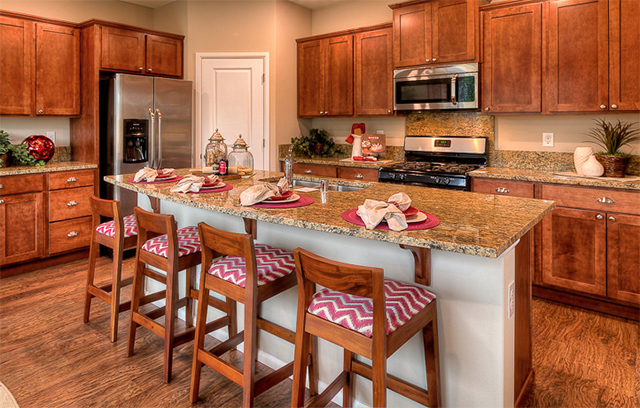
The kitchen is a great place to weave in some red accessories. Red is the color of extroverts, making it the perfect addition to a room where groups tend to gather. For many of us, that’s the kitchen- the heart of the home. Add a gentle wash of red, from seat cushions and placemats to glassware. A bonus for kitchens – studies have show that the color red can stimulate the appetite!

Searching for the perfect focal point for a room needing a little more excitement? Consider increasing the intensity with one or two bold pieces of furniture, like an arm chair, ottoman or side table. Red’s flexible nature allows it to work well with an already established color palette.

Jeannie Matteucci for HGTV.com echoes the versatility of red:
“An earthy red used with wood tones can warm a room. Red with soft gray and touches of magenta can make a room feel cozy, feminine and soft.”

While a highly saturated and intense pops of red are undeniably stunning, you’re not limited to just one shade. Who can forget blush and bashful, the quintessential wedding colors from the movie Steel Magnolias? Considering that light reds and pinks suggest romance, friendship and femininity, blush and bashful make the perfect backdrop for that particular movie.

If red feels too aggressive for your tranquil bedroom, shades of pinks and orange are a great alternative. For a girl or young woman’s bedroom, have fun with layering pinks of all tones, plus some lace and ruffles, for a feminine and serene bedroom.
If you want to avoid a distinctly feminine feeling in the master suite, add structured elements and darker tones to muted red shades for a space appealing to men and women, like the Lennar Austin example above.
Get even more ideas and inspiration for your red interior design!